
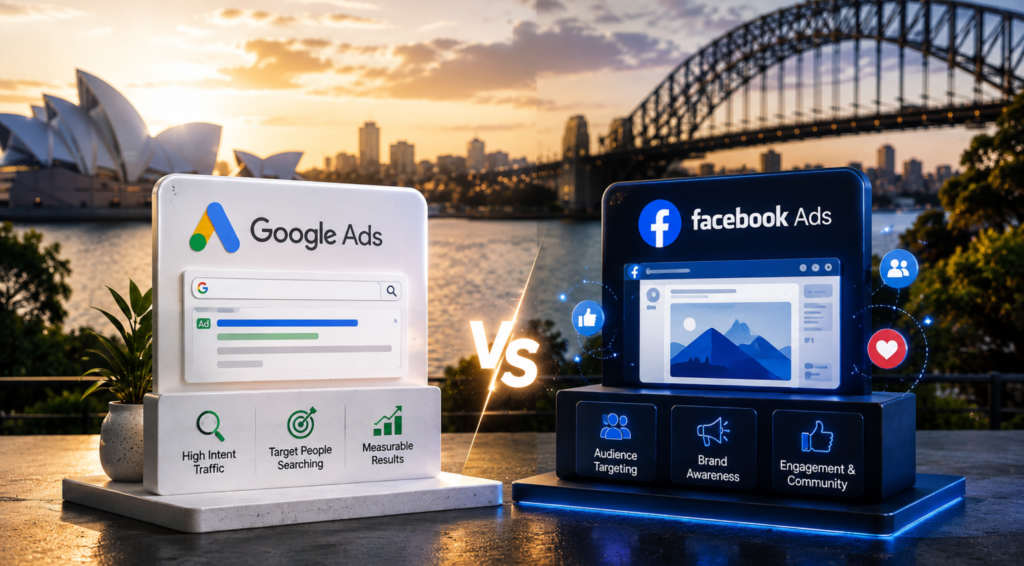
Where should you invest your ad budget this month? We know the choice between Google Ads vs Facebook Ads impacts every local business owner. The right choice boosts your profit margins. The wrong choice drains your budget fast. Let us review the facts. The following breakdown shows you where to spend your money.
At A Glance: Core Differences Between Platforms
Business owners need quick facts before moving forward. The table below provides a breakdown of both platforms.
| Feature | Google Ads | Facebook Ads |
| Primary Focus | Intent-based search demand | Interest and lifestyle discovery |
| Cost Dynamics | Higher intent-based cost baseline | Lower initial click cost baseline |
| Top Use Case | Urgent local services and search products | Visual e-commerce and brand building |
| Setup Focus | Keyword research and search intent match | Visual creative building and ad copy |
| Conversion Speed | Rapid conversion (hours to days) | Medium funnel speed (days to weeks) |
Core Operational Differences Explained
We need to compare the mechanics of both networks. Google is a search engine based on user intent. People type exact queries into the search bar. They actively look for products or specific services.
Meta operates completely differently. Facebook connects people and shares content. Users scroll through their feeds without direct purchase intent. Your ads interrupt their scrolling experience. This interruption must be visually appealing to work.
Aussie Marketing builds high-converting campaigns across both platforms daily.
Google Ads vs Facebook: Audience Reach Dynamics
Which platform dominates the current digital landscape? Both command huge audiences across Australia and the globe. The platforms approach the advertising space from opposite angles.
Google targets what people want right now. Facebook targets who people are based on user profiles. Both systems deliver strong results when used correctly. The strategy changes based on your business model.
A Breakdown Of Google Ads vs Facebook Ads Cost
Money matters when you plan a marketing budget. Google Search clicks generally cost more than Meta clicks, but CPC varies significantly by industry, competition, location, and campaign setup. In Australia, Facebook ad traffic often provides a lower cost-per-click entry point.
Google Search clicks carry a higher cost baseline due to direct purchase intent. Cost per click differs significantly based on key campaign variables:
- Industry Sector: An emergency plumbing campaign and an e-commerce store have completely different auction benchmarks.
- Geographic Location: Bidding in high-density capital cities like Sydney or Melbourne commands higher rates than regional areas.
- Search Intent & Match Type: Exact-matching keywords for commercial terms cost more than broad informational terms.
- Quality Score & Bidding Strategy: High ad relevance and landing page experience lower your actual auction cost.
Do not just look at raw click prices. Evaluation of Facebook vs Google Ads costs requires looking at your final cost per acquisition.
Australian Cost Dynamics By Industry
Ad auction costs fluctuate based on market demand and local competition. The table below outlines how campaign dynamics shift across key sectors:
| Industry Sector | Google Search CPC Behaviour | Facebook Ads CPC Behaviour | Dominant Channel Role |
| Urgent Trades & Legal | High competition & high CPC | Moderate CPC / Low intent | Google captures immediate service demand. |
| E-Commerce & Retail | Moderate CPC / High product intent | Low CPC / High visual impulse | Facebook creates visual product desire. |
| Local Hospitality | Moderate CPC / Local intent | Low CPC / Broad reach | Facebook drives local brand awareness. |
| Professional Services | High CPC / High deal value | Moderate CPC / Retargeting | Combined multi-channel lead capture |
Note: Actual campaign costs depend on location, quality score, match types, and bidding strategies.
Market Share Breakdown: Facebook vs Google Ad Revenue
The digital ad market is heavily contested. Both giants generate billions in ad revenue annually. Advertisers trust them with massive budgets.
High Facebook vs Google ad revenue data proves one key fact. Both platforms provide massive value to business owners. Google still holds the larger market share globally. Facebook remains strong in visual product advertising.
E-commerce: Google Shopping vs Facebook Ads
Online stores face a tough choice between platforms. Physical products require specific promotional strategies. Let us compare Google Shopping vs Facebook Ads.
Google Shopping displays product images right in search results. Click costs vary by category, match type, and local competition. Buyers see the price before they click. This format drives qualified traffic to your store.
Facebook excels at visual storytelling and impulsive buying. A great video ad can make a product go viral. You can target users based on lifestyle interests. Both channels work well for online stores.
Strategy: Facebook Ads vs Google Ads for Business
Local services thrive on Google search campaigns. Plumbers and roofers need people with immediate problems. You cannot effectively sell roof repairs through Facebook videos.
Creative products shine on Meta platforms. Fashion brands need to show their clothing in action. An aesthetic Instagram reel generates buying desire.
You must identify your core offering first. This step determines your primary advertising channel. A good Facebook Ads vs Google Ads for business strategy balances both platforms. Aussie Marketing helps clients navigate these choices every single day. A full Google Ads vs Facebook Ads comparison highlights these industry strengths.
Facebook vs Google Ads: Which System Fits Your Business Model?
It takes careful planning to choose your main channel. You need to review your current marketing goals. Are you trying to build brand awareness? Facebook is your best starting point. Do you want to capture ready buyers? Google search campaigns will deliver better results.
Facebook Ads vs Google Ads: Which is better for your specific goals?
The answer depends entirely on your sales cycle. Short sales cycles do well on Google. People search and buy within minutes.
Long sales cycles require more nurturing. Facebook retargeting campaigns keep your brand visible. Smart brands combine both platforms. They use Facebook to generate initial interest. They use Google to close the sale later.
Frequently Asked Questions
Facebook Ads usually offers lower initial click costs and lower impression rates. g more per click baseline but delivers higher initial conversion rates. Actual CPC varies depending on industry competition, location, and quality score. You must evaluate cost per acquisition rather than raw click prices alone.
Yes, this is a highly profitable strategy. You can build audience awareness on Facebook, then capture search queries on Google. This multi-channel approach increases total conversion volume. Aussie Marketing manages cross-channel campaigns effectively.
Google Search campaigns generate traffic immediately after account approval. Your ads appear on search result pages within hours. Leads can arrive on your first day of running ads.
LinkedIn is famous for B2B marketing. Facebook still plays a big role in B2B spaces. Business owners spend personal time on Facebook and Instagram. Meta retargeting for past website visitors is highly profitable.
Ad platforms feature complex settings and bidding rules. Mistakes in keyword matching or audience selection waste your ad budget. Aussie Marketing optimises campaigns to lower customer acquisition costs and deliver transparent, measurable ROI for Australian businesses.


