Are you spending your marketing budget on the wrong search strategy? Australian business owners constantly debate whether SEO vs Google Ads delivers higher quality leads and faster sales. The decision between SEO and Google Ads determines how fast your company scales online. Let’s go over this guide and compare Google Ads vs SEO to help you select the most profitable strategy for your long-term growth goals.
What Is Search Engine Optimisation?
Search engine optimisation focuses on improving website visibility. The primary goal is to appear higher in unpaid search engine results. Search engine optimisation brings consistent traffic over a long period.
The process includes technical fixes, content creation, and local link building. You do not pay for individual user clicks. Your site earns authority from search engines organically. Higher organic rankings lead to consistent website visitors and lower acquisition costs.
Key advantages of SEO over Google Ads
Search engine optimisation offers high long-term value.
- Long-Term Value: Once your site ranks on top, search traffic flows constantly without paying for individual visits.
- Brand Authority: Top organic rankings construct strong authority across your industry and market space.
- User Credibility: Australian consumers often trust organic search entries over paid positions.
- Lead Costs: The cost per lead drops significantly as your overall website traffic expands over time.
- Web Presence: Organic rankings create a solid foundation for your digital brand footprint that lasts for years.
- Sustainable Moats: High domain authority makes it difficult for new competitors to outrank your core service pages.
What Are Paid Search Advertisements?
Google Ads is a paid platform. It puts your brand at the top of search pages fast. You bid on target search terms. You pay a fee every single time a user clicks your link.
This setup works well for immediate lead generation. It allows new firms to gain visibility within hours. You control daily budgets and target locations across specific Australian regions.
Key Advantages of Paid Advertising
Paid campaigns offer full control over click spend.
- Geographic Targeting: Campaigns allow you to select specific Australian suburbs, postcodes, or cities.
- Complete Budget Control: You dictate exact daily ad spend caps and maximum click costs to maintain financial safety.
- Display Schedules: Ads show only during your operating hours or peak customer response times.
- Traffic Delivery: Search engine placements display right away once your new campaign launches.
- Market Testing: Paid clicks help test promotional offers and new services within a few days.
- Data Gathering: Real campaign metrics reveal high-converting search terms to inform your wider strategy.
- Campaign Management: Bids, budgets, and ad copy updates take effect instantly across active markets.
Core Differences: Organic Search vs Paid Search
You must understand how these two acquisition paths operate. Specific operational traits dictate which path suits your current business goals.
Take a look at this breakdown; it clarifies the real functional trade-offs of SEO vs PPC for growing businesses.
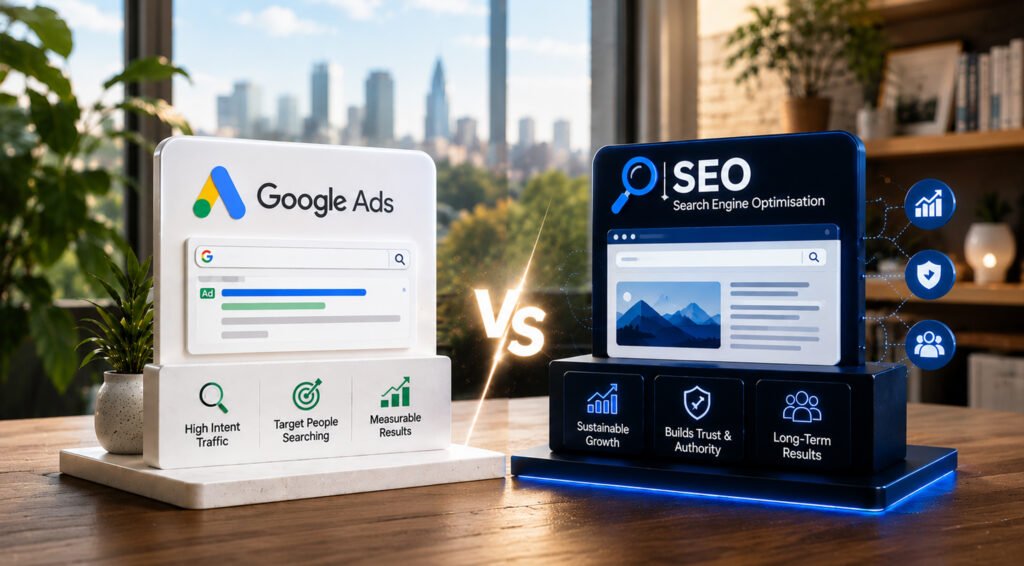
| Feature | Search Engine Optimisation | Google Ads (PPC) |
| Traffic Speed | Requires 3 to 6 months | Begins immediately |
| Cost Model | Fixed ongoing investment | Pay per user click |
| Long-term Value | High compounding equity | Stops when spend stops |
| User Credibility | High organic trust | Moderate ad trust |
| Top Placement | Below top paid slots | Top of search pages |
SEO compared to Google Ads: Cost Structures and ROI
Financial investments differ significantly between these paths. Let us analyse how budget allocations function over time.
Investment in Search Engine Optimisation
Search engine optimisation requires upfront capital. You invest in technical audit work, local agency services, and content assets.
The return on investment accumulates over several months. Website traffic stays steady even if monthly spend pauses temporarily. Over time, average cost per click trends towards zero.
Budget Allocation for Paid Advertising
A paid search requires an active daily ad spend account balance. Competitive Australian sectors face elevated cost per click fees.
Leads stop immediately when you pause your campaign spend. Constant account maintenance is necessary to eliminate non-converting terms and avoid wasted capital.
Australian Industry CPC Benchmarks and Search Behaviour
Cost per click figures vary wildly across Australia depending on local market density and commercial intent. An understanding of these sector averages helps business owners plan monthly spend accurately.
Typical Cost Per Click Averages Across Australian Sectors
- Emergency Trades (Plumbing, Electrical, Locksmiths): $15.00 to $55.00 per click.
- Legal and Financial Services: $20.00 to $65.00 per click.
- Commercial B2B Services: $8.00 to $30.00 per click.
- Home Services and Renovations: $6.00 to $22.00 per click.
- Local E-commerce Retail: $1.50 to $5.50 per click.
High-cost sectors face rapid cash flow drain from paid clicks alone. A combined organic search strategy cuts expensive bidding.
When Should You Choose SEO or Google Ads?
Your business timeline dictates your primary acquisition channel. Review these operational scenarios before you decide.
Situations That Demand Search Engine Optimisation
Select Search Engine Optimisation if you prioritise long-term brand equity. It suits companies establishing sustainable regional presence.
Plan for a six- to twelve-month implementation horizon. This builds a permanent digital asset for your company. Visit our SEO services page to get expert help.
Scenarios Best Suited for Google Ads
Select paid campaigns for immediate lead volume. New market entry and quick product launches require rapid exposure.
Time-sensitive campaigns depend on fast traffic deployment. You can view our specialised Google Ads optimisation services to control your cost per lead.
Search Intent Analysis: Commercial vs Informational Queries
Search engines categorise search queries by user intent. Align your content strategy with search intent to prevent wasted ad spend and improve organic ranking performance.
Strategic Alignment: Use paid ads to capture high-intent transactional keywords for instant leads. Use organic SEO content to answer research questions for building brand trust early.
| Search Intent Type | Target Strategy | Key Example Queries | Primary User Goal |
| High Commercial Intent | Google Ads (Paid) | “Plumber Sydney””Buy an office desk” | Immediate purchase or urgent service call |
| Research & Informational | SEO (Organic) | “How to unclog a drain””Best desk height for posture” | Gathering facts and comparing options |
High-Intent Transactional Queries
Transactional searches indicate the users ready to make a purchase or request a service call immediately. Phrases such as “emergency plumber Brisbane” or “book tax accountant Melbourne” carry high buying intent.
These keywords perform exceptionally well in paid ad campaigns because immediate visibility directly captures active buyers.
Informational and Research Queries
Informational queries indicate prospective customers researching solutions before committing to a provider. Phrases like “how to fix a leaking tap” or “small business tax deduction rules” show research intent.
Paid ad spend on informational terms yields low conversion rates and wastes budget. Organic blog articles for research queries build brand authority early in the customer decision-making process.
The Value of SEO and Google Ads Working Simultaneously
You do not need to pick just one channel. A combined campaign structure delivers the strongest overall results.
The ads and SEO running together give maximum coverage on search results pages. Paid search captures instant demand while organic efforts construct persistent market authority.
Combined Digital Search Strategy
Google Ads (Paid Search)
- Immediate traffic
- Instant testing
- High-intent leads
SEO (Organic Search)
- Compounding ROI
- High user trust
- Sustainable growth
Data Synergy: Paid keyword data informs organic assets
Shared Operational Benefits
Keywords that convert in paid campaigns reveal clear intent. Use that specific data to prioritise your organic search content creation.
High organic ranks for main paid keywords reduce your dependence on pay-per-click traffic over time. This setup protects your business from sudden advertising cost spikes.
Strategic Analysis: Google SEO vs Google Ads
User behaviour on search platforms shifts continuously. A number of Australian consumers ignore top sponsor labels completely. They scroll straight to high-ranking organic listings. This user pattern provides a large advantage to websites with top organic visibility.
Key Trade-Offs in Digital Marketing
Paid search gives fast feedback loops and exact targeting control. Organic search produces stronger user trust and superior long-term margins.
High-competition local service sectors achieve lower customer acquisition costs by using both channels strategically.
Why Relying on One Channel Increases Risk
Single-channel search strategies introduce real business risk. Paid ad costs increase yearly in competitive Australian markets.
Competitors can easily outbid your daily budget caps. Conversely, relying only on organic traffic requires patience. Algorithm updates can alter organic traffic patterns without notice.
A combined usage of paid and organic techniques spreads acquisition risk. It maintains continuous traffic flow across changing market environments.
Practical Setup Guide for Campaign Execution
Clear preparation determines campaign performance. Both search avenues require systematic execution.
Execution Plan for Organic Rankings
- Perform a thorough technical site audit to repair broken links and improve load speed.
- Conduct local keyword research to identify specific customer search phrases.
- Write direct, authoritative answers to customer questions.
- Establish local citations and optimise your Google Business Profile.
Execution Plan for Paid Search
- Select a high-intent phrase and exact search keywords.
- Establish strict daily account spend caps.
- Write direct ad copy focused on specific customer solutions.
- Direct traffic to dedicated, high-converting service landing pages.
Technical Performance Standards for Australian Websites
Site performance metrics directly impact both paid ad costs and organic search placement. Google measures page speed and mobile usability across all website types.
Core Web Vitals and Quality Scores
Google Ads assigns a quality score to every keyword in your account. Landing page speed and mobile optimisation, both measured through Core Web Vitals, directly determine this rating. Higher quality scores reduce your actual cost per click..
Search engine optimisation also relies heavily on technical website performance. Search engines prioritise fast websites that load quickly on mobile devices. An improvement in site speed boosts ad efficiency and organic positions at the same time.
Five Factors to Review Before Allocating Budget
- Available Capital: Do you have cash flow for pay-per-click costs?
- Timeline Demands: Do you require sales today or in the coming months?
- Sector Competition: Are local competitors spending heavily on top ad slots?
- Landing Page Quality: Can your site turn traffic into phone calls?
- Growth Objectives: Are you launching a new service or expanding brand equity?
Evaluating SEO compared to Google Ads
Think of these channels like real estate options. Paid search acts like renting business space. You get instant access to foot traffic. When you stop paying rent, your foot traffic stops immediately.
Organic strategy acts like buying real property. Initial acquisition requires time and capital outlay. Over time, you build strong asset equity that delivers value for years.
The Future of Digital Search Engine Performance
Search engine design continues to change rapidly. Sponsored listings occupy significant space on mobile screens.
Organic positions must deliver strong relevance to retain top placement. This makes the balance of organic search vs paid search necessary to monitor continuously. Operating ads and SEO together safeguards your market share across both paid and unpaid search segments.
Summary Decision Framework for Australian Business Owners
Use this clear decision framework to select your starting path:
- Select Paid Advertising First: If you need leads within 24 to 48 hours, have a short-term promotional budget, or need to validate a new service offer.
- Select Search Engine Optimisation First: If you have an established business, want to reduce acquisition costs over time, and can commit to a 6-month growth plan.
- Select a Blended Strategy: If you operate in a competitive Australian market, require steady leads now, and want to build lasting digital equity simultaneously.
Final Verdict
We can say that neither acquisition method is universally superior. Each serves a different business role depending on your budget, timeline, and market competition. Assess your financial resources carefully and select the path that aligns with your growth strategy.
Frequently Asked Questions
Which is better for a brand new website: SEO or Google Ads?
New sites lack domain authority, making organic growth slow initially. Paid search provides immediate traffic to launch sales right away. Use paid search first for fast cash flow while building organic content authority in the background.
Can I run SEO and Google Ads at the same time?
Yes, operating both channels together yields the best overall campaign performance. Paid ads deliver fast market testing, while organic search reduces long-term acquisition costs. Australian businesses regularly use both to maximise market reach.
How long does it take to see organic search results?
Organic search efforts typically show tangible traffic gains within three to six months. Highly competitive sectors may require up to twelve months. Consistent content development speeds up indexing and authority gains.
Is paid search a waste of money?
Paid advertising wastes capital only when setup or targeted poorly. You must restrict broad keyword matches and direct clicks to dedicated landing pages. Proper management ensures paid ad spend produces reliable returns.
Do paid ads improve my organic website rankings directly?
No, buying ads does not directly boost organic rankings. Google keeps paid and organic algorithms completely separate. However, paid visibility increases brand awareness, which can generate direct searches that indirectly aid site authority.